
"Eclipsing in size, splendor and impressiveness anything that has been built in the last few years of hectic theater construction, this new house is… beyond doubt the most gorgeous movie palace in the world."
That quote, reproduced in Robert Loerzel and James A. Pierce's book, "The Uptown: Chicago's Endangered Movie Palace," was penned by a Variety Magazine reporter who attended a preview event at the Uptown Theatre, 4816 N. Broadway, just before it opened to the public in 1925.
Today, JAM Productions owner and current Uptown Theatre steward Jerry Mickelson goes even further, calling the Uptown "the eighth wonder of the world."
But now, for 45 of the Uptown's 100 years — pushing half the time it has been standing — the general public has not been able to enjoy its size, splendor or impressiveness.
Following a concert by the J. Geils Band on Dec. 19, 1981, the doors to the Uptown Theatre slammed shut, only reopening for a handful of uses here and there in the decades since. More than one plan to reopen the Uptown has been announced with much fanfare and anticipation, only to get derailed.
Will crowds ever flock to the Uptown Theatre again? Mickelson says funding needs to be secured for that to happen. But for now, a rare opportunity will be made available for the public to go inside the Uptown, as the grand old movie palace will be part of the Chicago Architecture Foundation's Open House Chicago tour for the first time ever.
Mickelson said he has purposely kept the Uptown closed because he didn't want the public to see it until it was restored and reopened. But he said he needs the public's support to restore the landmark, so he decided it was time to allow the people to see what hides behind the locked doors.
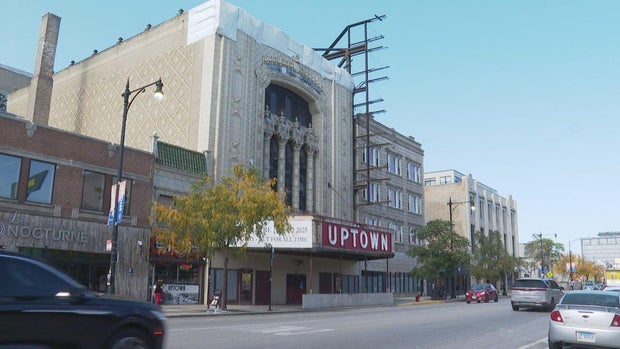
The bracing edifice of the Uptown Theatre is a familiar sight to Chicagoans. A trip on foot from the Vietnamese eateries of Argyle Street to a night of jazz at the Green Mill, for instance, would likely take you directly under the marquee.
"People who live near the Uptown have a relationship with this building, regardless of whether they've ever been able to come into it or not. It has a presence on the block, it's tall, it's ornamented, and people are fascinated by this place," said Adam Rubin, senior director of public engagement at the Chicago Architecture Center and an Uptown neighborhood resident.
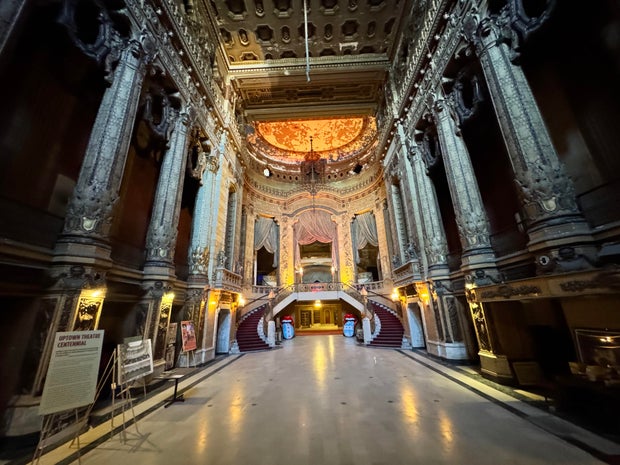
But generations of Chicagoans have only ever known the interior from photos and their own imaginations. It takes walking into the vast and opulent lobby to do justice to the majesty of the space.
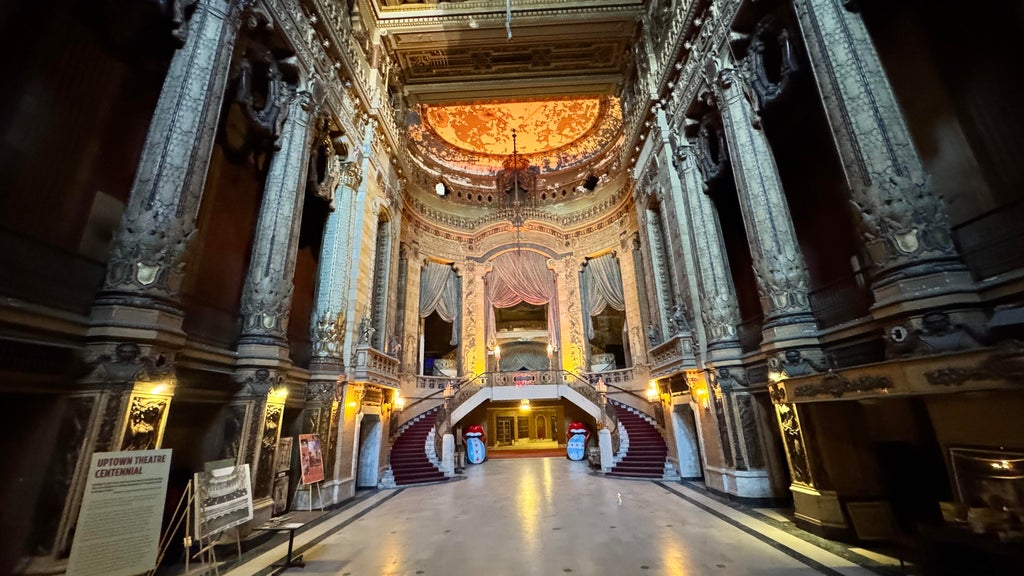
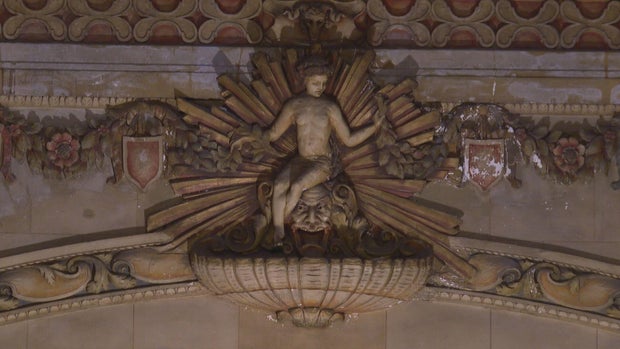
The six-story lobby goes all out with adornment and craftsmanship. It is flanked by towering columns and adorned with griffins, gargoyles, lion heads, shields emblazoned with serpents and mythical sea creatures
One could imagine Fred Astaire, Greta Garbo, or even Cinderella coming down the grand marble staircase with its red carpet that faces the visitor across the vast space upon walking in.
"Patrons who stepped past the Spanish Baroque Revival façade of the Uptown Theatre entered into the luxurious, six-story grand lobby felt like they were entering a palace," the Chicago Architecture Center wrote of the Uptown. "In fact, [architects] Rapp and Rapp wanted the 46,000-square-foot theater to imitate the palaces of Versailles or St. Petersburg, with statues, paintings and tapestries that were reproductions of the world's masterpieces."
It is only after taking in the grandeur that one notices the paint peeling in the soaring rotunda, or notices the faintly musty odor in the air. As Rubin said, the space would be striking even if it weren't shrouded in mystery after being closed for so many years.
"I think people have been fascinated with the Uptown since it opened in 1925. The story doesn't begin when it closed in 1981 and continue now," he said. "This was a building designed for people to be fascinated with. It has so many details and pulls from so many different elements of architectural history, of world history, that when you come in here, you're supposed to be floored."
Walk under the staircase and the ceiling lowers as a side lobby emerges to the right. The windows looking into the auditorium are lined with spindles in front of the glass. Meanwhile, Mickelson noted that every ceiling in the theater is different — a coffered ceiling with hexagonal panels gives way to plaster beams designed and painted to look like wood.
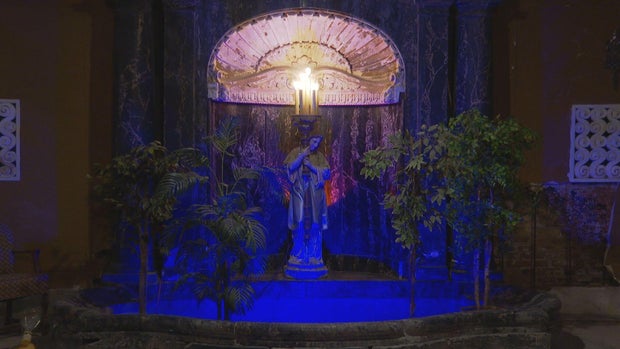
To the right, artificial houseplants stand in a currently dry fountain bedecked in blue light, and presided over by statue holding a candelabra-style light fixture like a torch.
Go up the stairs, and the theater's enormity becomes apparent.
"This theater is so large that they designed and built signs — street signs to give you an idea of what direction you were going, so there's a Broadway street sign that used to be in this lobby, there's a Lawrence, there's a Magnolia," Mickelson said.
Walk to the right at the top of the stairs, and you'll pass under an arch bedecked in drapes. But try to go back the other way, the doorway is rectangular rather than arched.
"The architects played with you," Mickelson said.
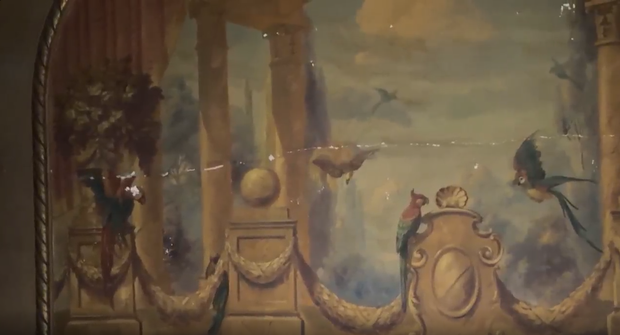
On the second level, what is known as the second balcony once had a Louis XIV desk where patrons could write postcards. Juliet balconies line the upper level of the auditorium, and turn your head when exiting a balcony and you'll see a mural by the renowned artist Louis Grell showing tropical birds hovering and perching amid a scene of classical architecture.
There are a few surprises in the form of artifacts from elsewhere lurking in the Uptown, like the clock from the former Goldblatt's store down the street, and the marquee from the old Coronet Theatre in Evanston.
There are also some spots where decay is noticeable. But plaster can be rebuilt.
A century ago, movie palaces could be found all around Chicago. Complementing the Uptown on the South Side are the Avalon Regal Theater on 79th Street off Stony Island Avenue — also now in search of funds to be reopened — and on the West Side, the Central Theater at Roosevelt Road and Central Park Avenue, home to the House of Prayer Church of God in Christ since 1971.
"This speaks to a time that Chicago's neighborhoods had these big opulent places to go to movies, to go to a vaudeville performance. That isn't the era that we live in anymore," Rubin said.
Like many of Chicago's most celebrated theaters the Uptown was part of the Balaban & Katz chain. Founded in 1916 by brothers A.J. and Barney Balaban and family friend Sam Katz, along with his father Morris, Balaban & Katz were also behind the Chicago Theatre, the Oriental Theatre — now the Nederlander Theatre — and the Riviera Theatre just across Lawrence Avenue from the Uptown, among many others. Balaban & Katz also founded Chicago's first commercial television station, the long-defunct WBKB-TV Channel 4.
Like many Balaban & Katz theaters, the Uptown was designed by architectural firm Rapp & Rapp, founded by brothers Cornelius and George Rapp who were described in published reports as "the Michelangelos of movie palace design." Similarly to the Chicago Theatre, the Rapp & Rapp team designed a balcony that spanned the breadth of the auditorium without any columns to block the spectators below, Loerzel and Pierce's book noted.
The Uptown was actually bigger than the Chicago Theatre, with more than 4,300 seats compared with 3,861 at the Chicago, Loerzel wrote.
In the Chicago Tribune, Loerzel wrote that the opening of the Uptown in 1925 was cause for a festival, complete with bands, trapeze artists and a madcap performer who set himself ablaze and submerged himself in water to extinguish the flames.
Even the marquee proclaimed the Uptown "one of the greatest art buildings of the world," featuring "an acre of seats in a magic city."
The Uptown opened in the era of silent film, accompanied by a massive Wurlitzer theater pipe organ described in some reports as the most expensive ever built. The Uptown would also sometimes bring in a full orchestra to accompany films.
The vast auditorium offered a sense of intimacy with floating clouds and twinkling lights like a visitor would still see at the Music Box Theatre in Lakeview today. The Uptown also offered "'state of the art' air conditioning and a perfuming system built under the seats," the Chicago Architecture Foundation said.
"All light on the auditorium ceiling was from coves and hidden grilles and was controlled by an immense dimmer-board backstage," wrote S.A. Remis for the Edgewater Historical Society's Edgewater Scrapbook newsletter in 1993. "The dimmer-board permitted the mixing of colors to any degree or in any hue anywhere in the entire house. Approximately 17,000 electric light bulbs were used in the theater."
Remis wrote that the Uptown also featured the largest and most modern "freezing and air-washing" plant of its time, changing over the air in the auditorium every two minutes.
In addition to movies, the Uptown offered vaudeville shows and concerts going back to its earliest days. The Marx Brothers took the stage to perform scenes from their Broadway show "The Cocoanuts" in 1928, while Duke Ellington performed in 1931, Loerzel wrote. Live entertainment at the Uptown eventually faded, but Balaban & Katz tried to bring it back in 1949 with a triple-bill show featuring Mel Tormé, Ella Fitzgerald, and Henny Youngman, according to the Literary Hall of Fame.
As the fortunes of the Uptown neighborhood declined in the mid-20th century, the Uptown Theatre declined too. The balcony was closed, and the Wurlitzer pipe organ was sold off in the 1960s to cover insurance costs, the Chicago Architecture Center noted. Some of the paintings and statues were sold off too.
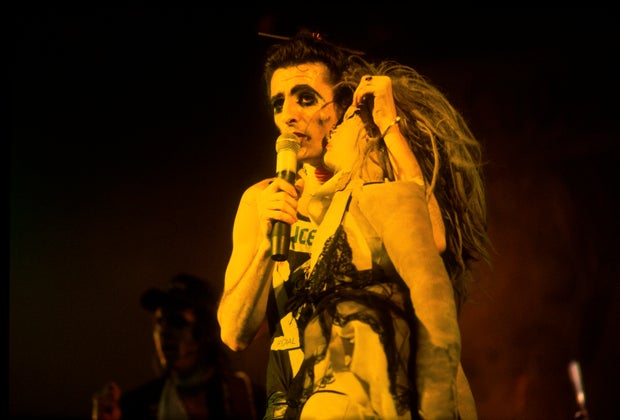
In the 1970s, the Uptown got a new lease on life as a rock concert venue, with JAM Productions handling booking and production. A who's who of A-listers of the era took the stage beginning in 1975: Bruce Springsteen, Frank Zappa, Rod Stewart, Alice Cooper, Lou Reed, Bob Marley, Prince, Rick James, Genesis, The Kinks, Electric Light Orchestra, Foreigner, Boston.
The Grateful Dead played 17 shows at the Uptown, reports said.

On. Dec. 19, 1981, the J. Geils Band took the stage at the Uptown and played all their hits — "Freeze-Frame," "Love Stinks, " "Musta Got Lost," "Centerfold." No one seems to have digitized a video or recording of the show and put it on the internet, but it's a safe bet that frontman Peter Wolf introduced "Musta Got Lost" with that famous spoken-word monologue with lines like, "Raputa the Beautah, flip me down your hair!"
But when the J. Geils band left the stage that night and someone flipped down the stage and house light switches, that was it.
Real estate businessmen Lou Wolf and Ken Goldberg bought the Uptown from the Plitt movie theater chain in 1980, the year before it closed, according to published reports. The late Wolf had a reputation as an unsavory character, having been convicted of arson in 1969, and also later serving prison time for attempting to evade taxes.
After that show in December 1981, Wolf and Goldberg not only closed the Uptown, but turned off the heat and left it abandoned, according to published reports.
Crain's Chicago Business recounted that by 1982, less than a year after the theater closed, it was practically left in ruins. The grand staircase was covered in 6 inches of ice and the basement was flooded with 4 feet of water. Changing seasons were of no help, as pest infestation, broken windows, and vandalism followed and summer humidity destroyed some of the beautiful plaster.
As Remis wrote in the Edgewater Scrapbook, there was talk early on of turning the Uptown into a flea market, or even of tearing it down. And indeed, many other movie palaces in Chicago did end up falling to the wrecking ball.
In the same quadrant of the city as the Uptown, the Granada in Rogers Park and the Nortown in West Rogers Park were also part of the Balaban & Katz chain.
The 3,400-seat Granada at 6427-41 N. Sheridan Rd., opened a year after the Uptown and was later purchased by Balaban & Katz. It also featured a Spanish Baroque motif, and was known as the gateway to the Rogers Park community, reports noted.
The Granada closed as a movie theater in 1978 and was used sporadically for rock concerts and midnight screenings of "The Rocky Horror Picture Show" into the 1980s, but ended up abandoned, boarded up, and ravaged by the elements and vandalism by the end of that decade. It was leveled in 1990. The Granada Center high-rise, occupied primarily by Loyola University, now stands on the site.
The 2,000-plus-seat Nortown, at 6320 N. Western Ave., opened in 1931 with an aquatic theme for its decor. The Nortown was where the late CBS Chicago movie critic Gene Siskel went to watch movies as a boy, and by the 1970s was the anchor of an entertainment district in an area of the city not really known for entertainment, with Sally's Stage offering theater pipe organ music and Vaudeville acts along with dinner right across the street.
The Nortown was converted from a single-screen theater to a triplex in 1984, and closed in 1990. The building morphed first into a church, then a community center. There was a plan to rehab the Nortown and reopen it as a venue for Indian and Pakistani films, but in 2007 the building was torn down. A Wendy's ended up being built on the site.
The Uptown escaped such a fate and instead was pressed into service for the 1991 movie "Backdraft," where a scene depicted a fire breaking out in the vacant structure. (No one came away with the impression that there was actually a fire at the Uptown, unlike the Pickwick Theatre in Park Ridge, where some people were fooled when it was rigged up with controlled flames and artificial smoke for the filming of the TV series "Chicago Fire" In 2022, and where a small fire actually did break out three years later.)
For the 1992 movie "Home Alone 2: Lost in New York," the lobby of the Uptown stood in for a rococo Midtown Manhattan toy store Duncan's Toy Chest, inspired by FAO Schwarz. The Uptown was also used in the 1994 Julia Roberts vehicle "I Love New York," and more recently in the 2013 blockbuster "Transformers: Age of Extinction."
The old theater has also allowed music videos to be filmed inside, and the lobby hosted dance parties to raise money for an HIV/AIDS charity in the 1990s.
But a successful plan to restore and reopen the Uptown has remained elusive.
In the early 1990s, when Wolf and Goldberg still owned the Uptown, theater restorer L. Curt Mangel launched a restoration plan for a cost of $8 million to $15 million, as reported in the Edgewater Scrapbook. Mangel and his team drained the water out of the flooded basement and installed a new roof in 1990, and a team cleaned the chandeliers and interior decoration.
But Mangel and developer Larry Mandell's plan to purchase and reopen the Uptown ended up falling through. Mandell told the Chicago Reader the city wouldn't contribute the funds needed for the restoration and repairs.
Meanwhile, while there was a deal in place for Wolf and Goldberg to sell the Uptown to Mangel and Mandell, the notorious landlords couldn't actually close on the sale, as they were behind more than $400,000 in property taxes, the Reader reported. So rather than going to the team that hoped to restore it, the Uptown ended up being auctioned off to somebody else at a tax auction.
By 2007, Mickelson wrote in the Chicago Tribune, a mortgage holder was floating a plan to turn the Uptown into an indoor go-kart track. Mickelson himself was motivated to come up with a plan to buy the Uptown himself, and he did just that at a foreclosure auction in 2008.
In 2018, Mayor Rahm Emanuel joined Mickelson in announcing a $75 million plan to restore the Uptown. The mayor had talked for years about a vision of the Uptown Theatre as a new crown jewel in an Uptown music district, along with the Riviera to the south, the Aragon Ballroom to the east, and the Green Mill just down the block.
Everything seemed to be going as planned at first. There was talk of bringing back the Uptown's chandeliers from the estate of Jasper Sanfilippo in Barrington Hills, where they spent many years in an estate that also includes a carousel and an assortment of mechanical musical devices.
Published reports at the time said the Uptown restoration project was set to begin in the summer of 2019 and be to be finished in 2021.
But then the COVID-19 pandemic hit. Farpoint Development, which had partnered with JAM Productions, withdrew from the project in 2021 — the year that had once been envisioned for completion.
When CBS News Chicago's Noel Brennan visited in 2024, Mickelson expressed continued hope for a new chapter for the Uptown, but there was nothing in the works.
Now, Mickelson says more funding is needed to go ahead. He said restoration costs now amount to $190 million.
"We are assembling a capital stack of funding sources, and we're short. We have a gap to fill, and we need that filled with the help of our city," he said.
Mickelson said he has purposely kept the Uptown closed because he didn't want the public to see it until it was restored and reopened. But decided it was time, hence the inclusion of the theater in the Open House Chicago tour.
"I thought, let's bring it out. Let's have the citizens and the residents of Chicago see this amazing what I call eighth wonder of the world that's sitting right there," Mickelson said. "I hope that they can see and they understand the significance of this building, not just for our city, but in a grand scale about this — this is one of the nicest theaters that was built in the country."
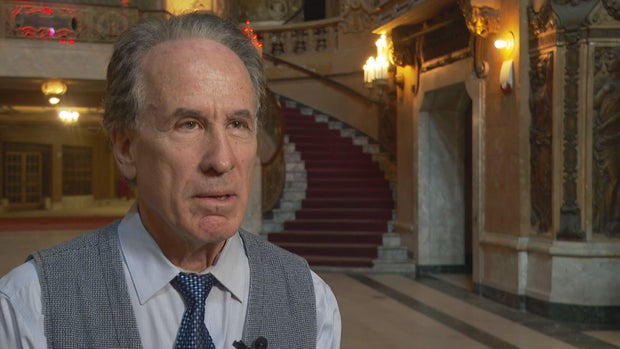
Could opening the building to public viewing help motivate people to push for more funding to restore Uptown? Mickelson hopes so.
"I would hope that would help. I want people to talk about it. I want them to talk to their politicians. I want them to start raising their voice, because I'm the sole person who's been carrying loads, and I can't do it myself," he said. "I'm not making enough progress, and maybe the voices of everyone else will help get us across the finish line."
Mickelson said he didn't know what might result from including the Uptown on the Open House tour, but he did have a warning.
"The bottom line is we can't let time take this building from us. This story will either end with a theater that's restored, or it'll end in silence, and the theater goes away," Mickelson said. "So before that happens, if it happens, I want people to see this. I want them to raise their voices, and say: 'We need to do something now. We can't keep waiting.'"
The Uptown Theatre will be open for Open House Chicago on Saturday, Oct. 17, and Sunday, Oct. 18, from 10 a.m. to 3 p.m. Visitors will enter through the lobby and take a brief tour. Open House Chicago is free and does not require tickets or reservations.
The Chicago Architecture Foundation emphasizes that photography will not be permitted at the Uptown during Open House Chicago.


