
Tallahassee City Commission candidate Dot Inman-Johnson has repeatedly cited the city’s roughly 25% poverty rate as one of Tallahassee’s most pressing problems. While the figure is consistent with the standard U.S. Census Bureau poverty measure, the Census data provide important context: college students substantially increase Tallahassee’s reported poverty rate and the rate has declined considerably over the last decade.
The latest U.S. Census Bureau American Community Survey five-year estimate puts Tallahassee’s poverty rate at 23.6% for 2020-2024, reasonably close to the 25% figure cited by Inman-Johnson. But Tallahassee’s large college population complicates the number.
A City of Tallahassee housing analysis citing a special Census calculation reported that, using 2019-2023 data, Tallahassee’s conventional poverty rate was 23.2%. When off-campus college students were excluded, the rate dropped to 16.5%, a reduction of 6.7 percentage points.
Students represented approximately 20.7% of the population in the analysis.
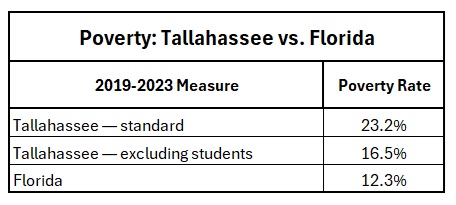
The adjustment eliminates a significant portion of the apparent difference between Tallahassee and Florida, but not all of it. Tallahassee’s student-adjusted rate remained 4.2 percentage points above Florida’s, or about 34% higher.
Tallahassee’s overall poverty rate has been moving lower.
Earlier Census research put the city’s conventional poverty rate at approximately 32.4% in 2009-2011. It fell to 28.4% in 2012-2016 and stands at 23.6% in the latest 2020-2024 Census estimate.
Census research has consistently found a substantial student effect. The 2012-2016 rate fell from 28.4% to 18.3% after off-campus students were excluded. The more recent 2019-2023 analysis reduced the rate from 23.2% to 16.5%.
The data therefore add important context to Inman-Johnson’s roughly 25% claim.


